Dissertation Read
A Definition of Rurality
A Sequential Quantitative Analysis Aligning Education to Geography
Outstanding Dissertation Award. UCWHRE pending.
Investigating the qualification criteria for policy, aligning it to places eligible for aid within policy, and those that receive it will further contribute to the growing understanding of the socioeconomic divide in the United States. The context should not be what is rural and what is urban; it appears this is not the correct question as the rural condition does not map into geographic areas delineated in existing data sources. Instead, any future inquiry should be into the barriers that prevent places needing aid from receiving it.
Dissertation Read
A Sequential Quantitative Analysis Aligning Education to Geography
Outstanding Dissertation Award. UCWHRE pending.
In a rural-urban dichotomy, the locale system lacks sensitivity to local variations, and up to 98.1% of places an urban school district administrates may be considered rural.
Definitions of rural and urban shape public policies, creating legislative action that lessens impediments, builds prospects, or offers other motivations influencing policymaking decisions. In the United States, the development of many existing policies and programs is to support rural places and bridge the economic gap between them and urban places.
Classifications of rural used by the Federal government justify the planning, application, and monitoring of policy interventions and development efforts to meet the needs of a population, creating an exacerbation of resource issues when different agencies fund communities with departments specific definitions.
The growing health, education, and infrastructure disparities between rural and urban areas are due to the lax standard for spatially structuring places. Using any of the most frequently cited Federal definitions and characteristics of rurality, the percentage of the population classified as rural can vary from 17 to 49%.
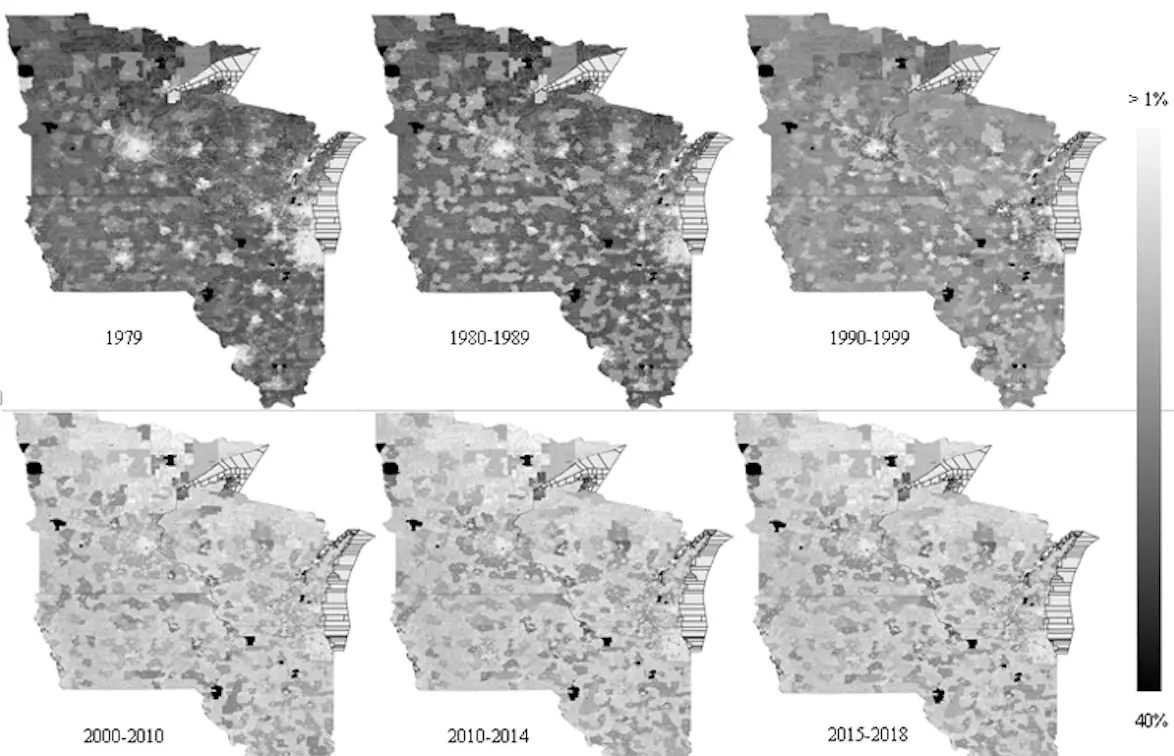
The purpose of this sequential quantitative, descriptive, and correlational study is to mathematically capture an essence of place by applying administrative, land-use, economic concepts, and socioeconomic characteristics of each NCES locale classification using data from the United States Census Bureau and American Community Surveys to describe the existing conditions in which policy derives.
The data delineated in the geographic areas of the NCES, American Community Surveys, United States Census Bureau, and School District Administrative Areas does not inherently link across agencies.
Census blocks are the smallest administrative partition offered by the USCB. Using census block groups or blocks, may lead to a better understanding of the disagreement between institutional locations and the populations they serve.
The NCES, USCB, and school administrative area layers are stacked, allowing spatial boundary intersection calculations and attributes to be linked across agencies.
193 Quantitative Descriptors